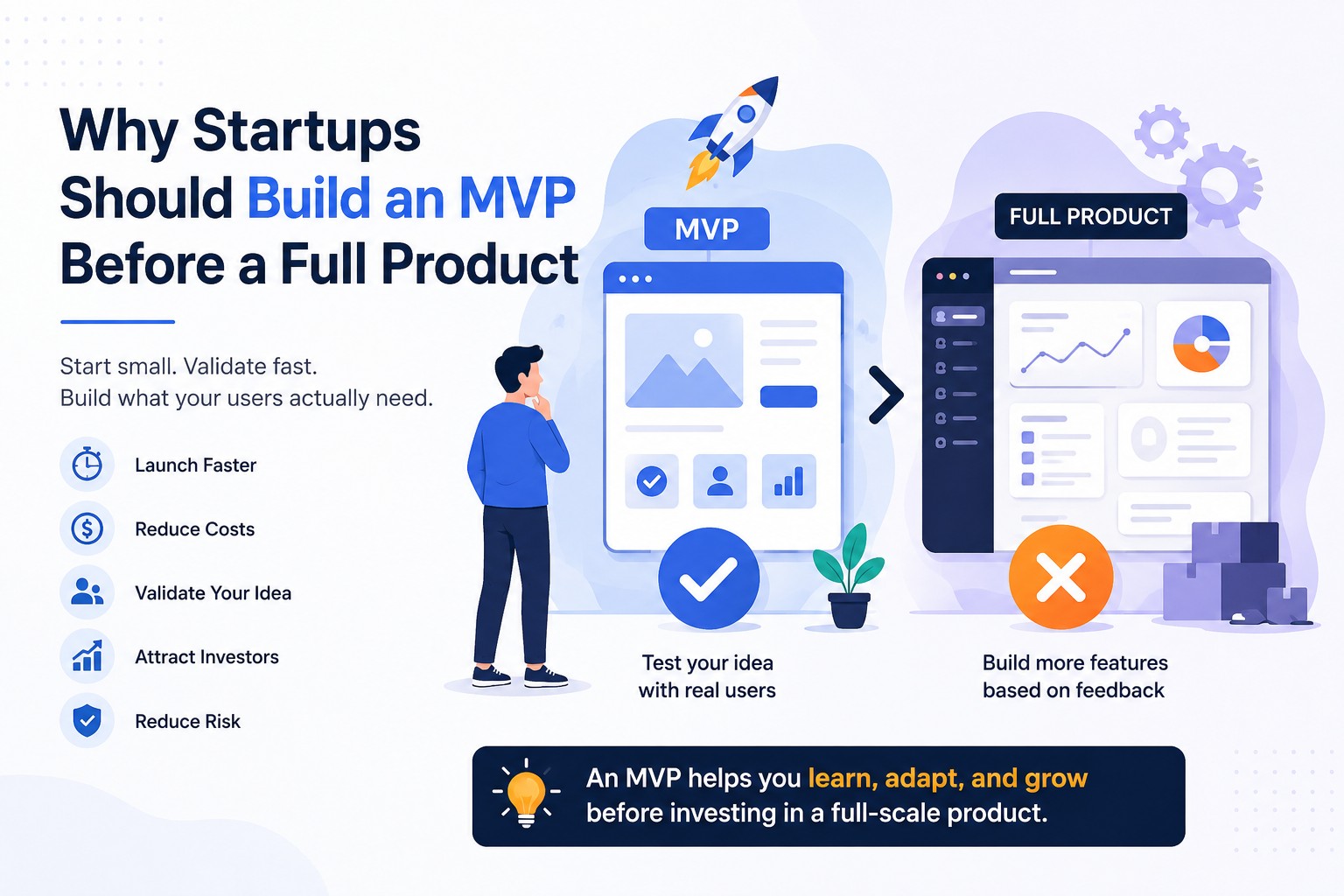
Why Startups Should Build an MVP Before a Full Product
Launching a startup is exciting. You have an idea that could solve a real problem, attract customers, and even transform an industry. Naturally, it's tempting to build the perfect product before showing it to the world.
But here's the reality: many startups don't fail because they have bad ideas—they fail because they spend too much time and money building products that customers never asked for.
That's why successful startups take a different approach.
Instead of building a complete product from day one, they launch a Minimum Viable Product (MVP)—a simple version of their idea that focuses on solving one important problem. Once real users start using it, they gather feedback, improve the product, and grow with confidence.
In this article, we'll explore why every startup should build an MVP before investing in a full product.
What Is an MVP?
An MVP (Minimum Viable Product) is the first functional version of your product that includes only the core features needed to solve a customer's primary problem.
Think of it as the foundation of your product not the final version.
Instead of trying to include every feature imaginable, an MVP allows you to launch quickly, test your idea in the real world, and learn directly from your users.
The goal isn't perfection.
The goal is learning.
Why Building a Full Product First Is Risky
Many founders believe that adding more features will make customers happier.
Unfortunately, that's rarely the case.
Building a complete product before validating your idea often leads to:
- Spending thousands of dollars on unnecessary features
- Delayed product launches
- Running out of budget before finding customers
- Building solutions that nobody actually needs
Without real user feedback, every decision is based on assumptions.
And assumptions are expensive.
The Biggest Benefits of Building an MVP
Validate Your Idea Early
Before investing months of development, you need to know one thing:
Do people actually want this product?**
An MVP answers that question quickly.
Real customer feedback is far more valuable than opinions from friends or colleagues.
Reduce Development Costs
Building only the essential features keeps your initial investment low.
Instead of spending your entire budget on Version 1, you can invest gradually as your product grows.
This approach gives startups more financial flexibility and significantly reduces risk.
Launch Faster
In today's competitive market, speed matters.
The sooner your product reaches customers, the sooner you begin collecting valuable insights.
Launching early also allows you to stay ahead of competitors and improve your product continuously.
Learn from Real Users
Customers often use products differently than founders expect.
An MVP helps you discover:
- Which features users actually love
- Where users get stuck
- What should be improved
- Which ideas should be removed
These insights help you build a better product over time.
Attract Investors
Investors don't just invest in ideas.
They invest in traction.
A working MVP demonstrates that:
- Your team can execute
- Customers are interested
- The market has potential
- Your startup is moving forward
Even a small group of active users can make a big difference during fundraising.
Minimize Business Risk
Every startup involves uncertainty.
An MVP allows you to validate your assumptions before making larger investments.
If something isn't working, you can adapt quickly without wasting months of development.
What Should an MVP Include?
A great MVP focuses on solving one problem exceptionally well.
Your first version should include:
- Core functionality
- Clean and intuitive user interface
- Secure login system
- Mobile-friendly design
- Reliable performance
- Basic analytics
Everything else can wait.
Features You Can Add Later
Many startups try to do too much too soon.
Avoid adding features like:
- Advanced dashboards
- AI recommendations
- Multiple integrations
- Complex reporting
- Premium customization
- Social features
Remember, your first goal is validation—not perfection.
Real Examples of Successful MVPs
Some of the world's biggest companies started with surprisingly simple products.
Airbnb
Airbnb began with a basic website where the founders rented out space in their own apartment to test demand.
Dropbox
Dropbox validated its idea using a short demonstration video before investing heavily in development.
Facebook initially launched only for Harvard students before expanding globally.
Uber
Uber started in a single city with limited functionality and grew after validating market demand.
These companies succeeded because they learned before they scaled.
Common MVP Mistakes to Avoid
Many startups delay success by making avoidable mistakes.
Avoid these common pitfalls:
- Trying to build every feature at once
- Ignoring customer feedback
- Waiting for the "perfect" launch
- Building without market research
- Making assumptions instead of testing ideas
Your product doesn't need to be perfect.
It simply needs to solve a real problem.
How TriAlpha Helps Startups Build Better MVPs
At TriAlpha, we help founders transform ideas into scalable digital products.
Our MVP development services include:
- Product Discovery
- UI/UX Design
- Full-Stack Development
- SaaS Development
- AI Integration
- Cloud Deployment
- Performance Optimization
- Long-Term Product Scaling
Whether you're building a SaaS platform, AI application, marketplace, or custom business software, our team focuses on delivering products that are built for growth.
Final Thoughts
Every successful startup begins with a simple idea—but not every startup begins with a perfect product.
Building an MVP allows you to validate your concept, reduce development costs, launch faster, and create a product that evolves based on real customer needs.
Instead of spending months building features nobody may use, focus on solving one problem exceptionally well.
Your customers will tell you what to build next.
That's the true power of an MVP.
Frequently Asked Questions
What does MVP stand for?
MVP stands for Minimum Viable Product, the simplest version of a product that delivers value while allowing startups to collect customer feedback.
How long does it take to build an MVP?
Most MVPs can be developed within 6–12 weeks, depending on the project's complexity.
Is an MVP cheaper than a full product?
Yes. Since it focuses only on essential features, an MVP is significantly more affordable than building a complete product.
Can an MVP become a full product?
Absolutely. Most successful software products evolve from an MVP into a complete solution based on customer feedback and business growth.
Ready to Build Your Startup?
Have an idea but don't know where to start?
TriAlpha helps startups design, develop, and launch scalable MVPs that validate ideas, attract customers, and prepare businesses for long-term success.
Let's build something great together.