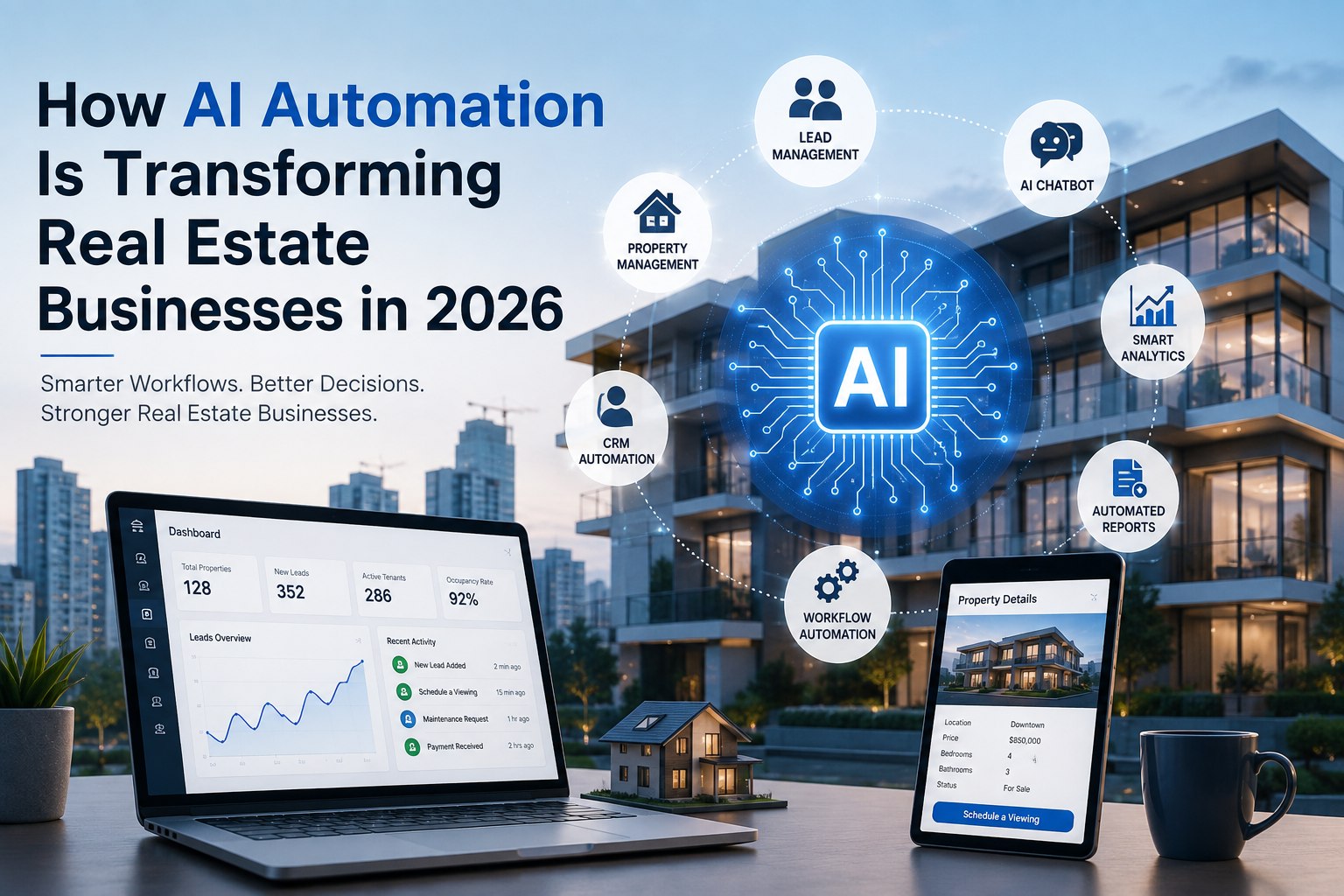
How AI Automation Is Transforming Real Estate Businesses in 2026
The real estate industry is becoming more technology-driven every year. Real estate companies are no longer relying only on spreadsheets, phone calls, and manual processes to manage their properties, customers, and leads.
In 2026, AI automation is helping real estate businesses work smarter, respond faster, and reduce repetitive tasks.
From automatically qualifying leads to managing maintenance requests and generating business reports, AI can now handle many everyday processes that previously required hours of manual work.
For real estate agencies, property managers, brokers, and growing property businesses, AI automation is becoming an important part of building a more efficient and scalable operation.
What Is AI Automation in Real Estate?
AI automation combines artificial intelligence with automated workflows to perform repetitive business tasks with minimal manual involvement.
A real estate business can use AI automation to:
- Capture and organize leads
- Qualify potential buyers and tenants
- Send automated follow-ups
- Answer customer questions
- Schedule property viewings
- Manage property information
- Track maintenance requests
- Generate reports
- Analyze business data
- Update CRM records
Instead of employees spending their time on repetitive administrative work, AI can handle routine processes while teams focus on customers, sales, and business growth.
1. AI-Powered Lead Management
Generating leads is only the first step. The bigger challenge is managing those leads effectively.
Real estate companies receive leads from websites, social media, advertisements, property portals, and other channels. Managing every lead manually can quickly become difficult.
AI can automatically analyze incoming leads and identify important information such as:
- Property requirements
- Preferred location
- Budget
- Buying or renting preference
- Expected timeline
The system can then categorize leads and send high-priority prospects to the appropriate sales representative.
This helps sales teams spend more time with serious prospects instead of manually sorting through every inquiry.
2. Automated Follow-Ups
Many potential customers do not make a decision after the first conversation.
Consistent follow-ups are therefore extremely important in real estate. However, manually remembering when and how to follow up with every prospect can consume a lot of time.
AI-powered automation can create personalized follow-up workflows.
For example:
New Lead → AI Qualification → Personalized Message → Follow-Up → Sales Notification
If the prospect doesn't respond, the system can automatically send another follow-up based on predefined rules.
This keeps potential customers engaged without requiring employees to manually track every conversation.
3. AI Chatbots for Real Estate Websites
Real estate websites receive questions throughout the day.
Customers may want to know:
- Which properties are available?
- What is the property price?
- Where is the property located?
- How many bedrooms does it have?
- Is the property available for rent?
- Can I schedule a viewing?
An AI chatbot can answer many of these questions instantly.
Unlike traditional contact forms, an AI assistant can interact with visitors, collect their information, understand their requirements, and pass qualified leads to the sales team.
This also gives customers access to assistance outside normal business hours.
4. Smarter Property Management
Managing properties becomes increasingly complicated as a business grows.
Property managers may need to keep track of tenants, leases, rent payments, maintenance requests, inspections, documents, and communication.
Using multiple spreadsheets and disconnected tools can make this process inefficient.
A custom property management system can bring these operations together in one centralized platform.
AI can further improve the system by helping categorize requests, identify patterns, automate communication, and generate useful reports.
Instead of constantly switching between different tools, property managers can manage important operations from a single system.
5. Automated Maintenance Management
Maintenance is another area where automation can make a significant difference.
A traditional process might involve a tenant sending an email, a property manager manually reviewing it, contacting a technician, and then updating the tenant.
AI automation can simplify this workflow:
Tenant Request → AI Categorization → Priority Assignment → Team Notification → Status Tracking → Tenant Update
For example, an urgent maintenance request can be prioritized automatically, while less critical requests can be placed into a normal queue.
This creates a faster and more organized maintenance process.
6. AI-Powered Real Estate Analytics
Real estate companies generate a large amount of data.
This can include property information, sales, rental activity, customer behavior, marketing performance, revenue, and occupancy rates.
AI can analyze this data and turn it into useful insights.
Businesses can use AI-powered analytics to understand:
- Which properties receive the most interest
- Which marketing channels generate better leads
- Which locations have higher demand
- Which leads are more likely to convert
- Where operational costs can be reduced
Instead of relying entirely on assumptions, management teams can use data to make better business decisions.
7. CRM Automation for Real Estate
A CRM helps real estate companies organize customer information and sales activities.
However, manually entering and updating CRM data can still take significant time.
AI automation can connect different parts of the sales process.
For example:
Website Lead → CRM → AI Qualification → Sales Assignment → Automated Follow-Up → Conversion Tracking
This creates a connected workflow where information automatically moves between different stages.
The result is a cleaner CRM, fewer manual tasks, and a more organized sales process.
8. Custom SaaS Platforms for Real Estate
Every real estate company has its own processes and requirements.
Off-the-shelf software can be useful, but it may not always provide the exact features a growing business needs.
This is where custom real estate SaaS development can provide an advantage.
A custom platform can be built around a company's specific requirements, including:
- Property management
- CRM
- Tenant management
- Lead management
- Payment tracking
- Reporting dashboards
- Document management
- AI automation
- Third-party integrations
The platform can also evolve as the company grows and its requirements change.
9. Benefits of AI Automation for Real Estate Businesses
AI automation can provide several practical benefits.
### Save Time
Repetitive administrative tasks can be automated, allowing employees to focus on more valuable activities.
### Improve Customer Response
AI assistants and automated workflows can respond to customers quickly, even outside normal business hours.
### Reduce Manual Work
Automating data entry, follow-ups, notifications, and reporting can reduce unnecessary manual processes.
### Improve Lead Management
AI can help businesses identify and prioritize promising prospects.
### Make Better Decisions
AI-powered analytics can turn large amounts of business data into actionable insights.
### Support Business Growth
Automated systems can help businesses handle increasing numbers of leads, customers, and properties without creating the same level of additional manual workload.
What Should Real Estate Companies Automate First?
Businesses don't need to automate everything at once.
A better approach is to start with processes that are repetitive, time-consuming, and easy to standardize.
For example:
1. Identify repetitive tasks.
2. Measure how much time they consume.
3. Choose the highest-impact process.
4. Build and test the automation.
5. Measure the results.
6. Expand automation to other areas.
Starting with one or two important workflows can help a business understand the value of AI before expanding its automation strategy.
The Future of Real Estate Is AI-Powered
AI automation is changing how real estate businesses operate.
From lead generation and customer communication to property management, CRM, analytics, and reporting, AI can help companies create faster and more efficient workflows.
The goal isn't to replace every human process.
The goal is to automate repetitive work so people can focus on the work that matters most.
Real estate businesses that invest in intelligent technology today can build more scalable and efficient operations for the future.
How TriAlpha Solutions Can Help
At TriAlpha Solutions, we help businesses transform ideas and operational challenges into scalable digital solutions.
For real estate companies, we can help build and integrate:
- AI-powered real estate solutions
- Property management systems
- Custom CRM platforms
- Real estate SaaS applications
- AI chatbots
- Workflow automation
- Custom web applications
- Business dashboards
- API and third-party integrations
Whether you want to automate lead follow-ups, build a property management platform, or develop a custom AI-powered SaaS product, our team can help turn your idea into a practical digital solution.
Ready to Automate Your Real Estate Business?
If your team is still spending hours managing spreadsheets, manually following up with leads, entering data, or switching between disconnected tools, it may be time to explore AI automation.
Build smarter. Automate faster. Scale with confidence.
Learn more about TriAlpha Solutions: https://www.trialphasolutions.com/
Have an idea for an AI-powered real estate solution? Let's discuss how we can turn it into a scalable product.